Does My Business Really Need a Website?
Your business is on social media, customers can reach you on WhatsApp, and you're already making sales. So, do you really need a website?
It's a fair question.
Perhaps your business already has an Instagram page, a Facebook account, or a WhatsApp Business profile. Maybe most of your customers come through referrals, and business has been going well without a website.
If that's the case, investing money in a website might seem unnecessary, especially when you have other business expenses to worry about.
But here's something worth considering.
What happens when a potential customer wants to learn more about your business, but you don't have a central place where they can find everything they need to know?
That's where a website can make a real difference.
Let's look at what a website can actually do for your business, when you need one, and whether it's worth the investment.
1. Your Social Media Page Isn't the Same as a Website
Social media has become an important tool for businesses. It helps you showcase your products, connect with customers, share updates, and attract new audiences.
There's absolutely nothing wrong with using it.
However, your social media presence and your website serve different purposes.
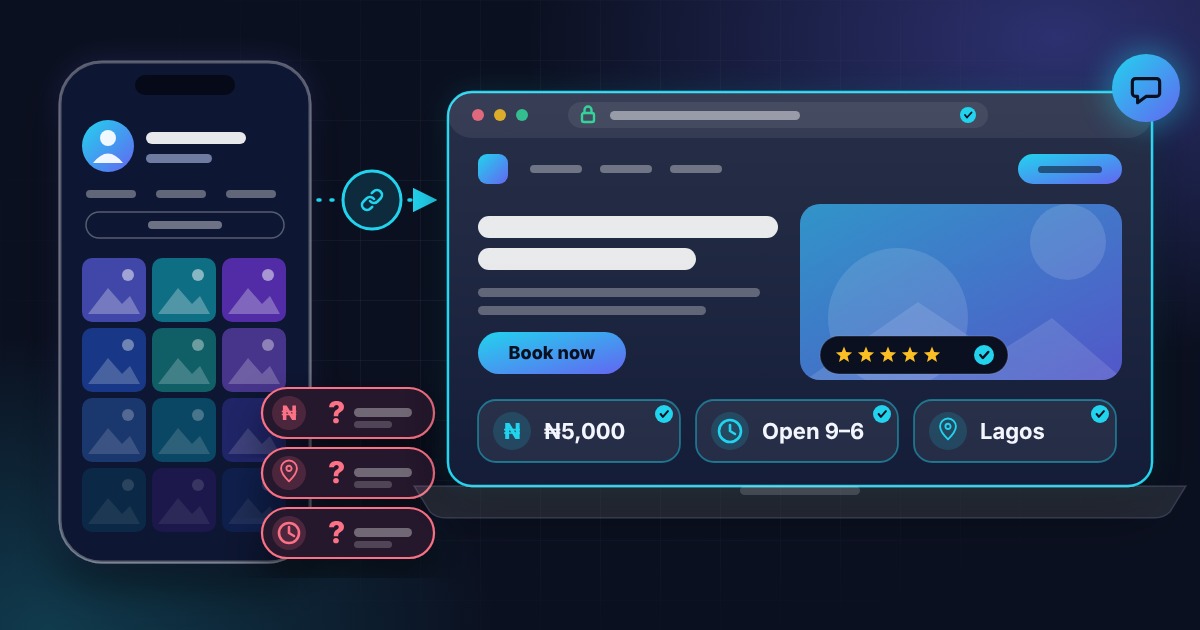
Think of social media as a place where people discover and interact with your business. Your website, on the other hand, can serve as a central destination where they learn about your business, explore your services, view your work, and take the next step.
Imagine someone recommends your bakery to a potential customer.
The customer searches for your business online but finds only a social media page with scattered posts, old promotions, and limited information about your products.
They might have to send you a message to ask about your menu, prices, delivery options, and location.
Now imagine that same customer visiting your website and immediately finding your menu, product images, opening hours, location, and ordering information.
Which experience makes it easier for that customer to make a decision?
A well-designed website can help you provide that second experience.
And when you make it easier for people to understand your business, you remove unnecessary obstacles between interest and a potential sale.
You can continue using social media to attract attention while directing interested customers to your website for more information.
The two can work together.
2. A Website Helps Build Trust and Credibility
Before spending money on a product or service, people often want to know whether they can trust the business they're dealing with.
This is particularly important when customers are discovering your business for the first time.
They may have questions such as:
- Is this business legitimate?
- Does it have experience in what it offers?
- Can I see examples of its work?
- How do I contact the business if something goes wrong?
- Why should I choose this business over another?
A professional website gives you a place to answer these questions.
You can introduce your business, explain your services, display customer testimonials, showcase previous projects, and provide clear contact information.
For a fashion brand, this might mean displaying product collections and size guides.
For a consultant, it could mean presenting professional experience, services, and client results.
For a school, it might include information about its facilities, curriculum, admissions process, and contact details.
The goal isn't simply to have a beautiful website.
It's to give potential customers enough relevant information to understand your business and feel more confident about taking the next step.
Of course, a website alone doesn't guarantee trust. Your business still needs to deliver quality products, provide good customer service, and keep its information accurate.
But a well-built website can help you communicate your professionalism more effectively.
3. Your Business Can Be Found Beyond Social Media
Imagine someone searching Google for a service you offer in their area.
A business owner might search for a web designer in Lagos, while a parent might search for a private school in their neighbourhood.
If your business has a relevant, well-optimised website, it has an opportunity to appear in those search results.
Without a website, you may miss some of those opportunities.
This is where search engine optimisation, commonly called SEO, becomes useful.
SEO involves improving your website and its content to help search engines understand your pages and connect them with relevant searches.
For example, a bakery in Lagos could publish useful information about its cakes, custom orders, delivery areas, and celebration packages.
A digital agency could publish articles answering common questions about website development, branding, and online visibility.
When these pages provide genuinely useful information and are properly optimised, they can help businesses reach people actively looking for what they offer.
However, it's important to understand that having a website doesn't automatically put your business on the first page of Google.
Search visibility takes time. Relevant content, technical optimisation, competition, and other factors all play a role.
The advantage is that your website gives you a foundation for building that visibility.
You can also explore our article on Generative Engine Optimisation (GEO) and optimising your website for AI search to learn more about improving how your business information can be discovered online.
Instead of depending entirely on people stumbling across your social media posts, you can work towards attracting people who are already searching for your products or services.
4. A Website Can Help You Save Time
How often do customers ask you the same questions?
What's the price?
Where are you located?
What services do you offer?
How can I place an order?
Do you deliver?
These questions are normal, but answering every one individually can consume a significant amount of your time.
A website can help reduce that workload.
You could create dedicated pages for your services, pricing information, frequently asked questions, delivery policies, booking processes, and other details customers regularly request.
Instead of explaining everything from scratch, you can direct customers to the relevant page.
For example, if someone asks about your services on WhatsApp, you could share a link to your services page.
If a customer wants to understand how your booking process works, you can direct them to a page that explains the steps.
Depending on how your website is built, you could also include online booking, order forms, payment integrations, or other features that reduce manual work.
This doesn't mean a website will eliminate the need to communicate with customers.
Rather, it helps you handle routine enquiries more efficiently, giving you more time to focus on running your business.
5. You Can Turn Your Website Into a Sales Tool
A website doesn't have to be a digital brochure that people visit and leave.
When designed around your business goals, it can help move potential customers from discovering your business to making a purchase or enquiry.
Consider an example.
You run a business offering professional photography services.
Someone discovers your work through Instagram and wants to know more.
They visit your website and find your portfolio, photography packages, customer testimonials, and booking information.
After reviewing everything, they complete an enquiry form or book a consultation.
Your website has helped guide that person through several steps without requiring you to explain everything manually.
Depending on your business, your website could help you:
- Generate enquiries from potential customers.
- Accept bookings and appointment requests.
- Sell products directly online.
- Collect leads for follow-up.
- Display your portfolio and previous projects.
- Promote specific services or offers.
- Direct visitors to WhatsApp for conversations and orders.
The right features depend on how your business operates.
A restaurant may benefit from an online menu and reservation system. An e-commerce business may need a product catalogue, shopping cart, and secure payment integration. A service provider may need a portfolio and enquiry form.
The goal is not to build a website with as many features as possible. It's to build one that helps your business achieve specific goals.
If you're exploring website options for your business, visit Emmy STACK01's website solutions page to see where to start.
6. Your Business Needs a Digital Home You Can Control
When you build your business entirely around a social media platform, your online presence depends heavily on that platform.
Changes to its algorithm, policies, features, or account access can affect how you reach your audience.
Your website gives you another channel through which customers can discover and interact with your business.
You can organise your information, create pages around your services, publish articles, showcase your work, and direct visitors towards the actions you want them to take.
You also have greater control over your website's design, content, and functionality, depending on your hosting arrangement and the tools you use.
However, owning a website doesn't mean you own every part of its infrastructure. Your domain registrar, hosting provider, and other third-party services still have their own terms and limitations.
That's why it's important to use reliable providers and maintain access to your domain, hosting, website files, and relevant accounts.
Your website works best as part of a broader digital strategy.
You can continue using social media to attract attention, WhatsApp to communicate with customers, and your website to provide detailed information and support enquiries or sales.
These channels don't have to compete with one another. They can work together.
7. But Does Every Business Need a Website Right Now?
Here's the honest answer: not every business needs a website immediately.
If you're just starting out, have a very limited budget, and are still testing whether people want your product, you might be better off focusing on getting your first customers.
A WhatsApp Business profile, social media page, and simple way to receive payments or orders may be enough to get started.
You don't necessarily need to invest in a complex website before you've validated your business idea.
However, as your business grows, your needs may change.
A website becomes increasingly worth considering when:
- Customers regularly ask for more information about your business.
- You want to reach people beyond your existing social media audience.
- Your competitors have websites that help them attract customers.
- You're spending too much time answering repetitive questions.
- You need a professional place to showcase your products or services.
- You want to publish content that can attract search traffic over time.
- You're ready to accept bookings, generate leads, or sell products online.
- You want to build a stronger and more consistent online presence.
The important thing is to assess your actual business needs rather than building a website simply because other businesses have one.
And remember, you don't have to start big.
A simple, well-designed website with the right information can be more useful than an expensive website filled with features your business doesn't need.
8. How Much Should You Invest in a Business Website?
The cost of a website depends on several factors, including its design, functionality, content requirements, integrations, and ongoing maintenance.
A basic business website with a homepage, services page, about page, and contact information will generally require less investment than a custom e-commerce platform with inventory management, customer accounts, and payment integrations.
Before deciding on a budget, ask yourself three questions.
First, what do I want my website to achieve?
Are you trying to build credibility, attract enquiries, showcase your work, accept bookings, or sell products online?
Your answer will help determine which features you actually need.
Second, what does my business need today?
Avoid paying for complex features simply because they sound impressive.
Start with what will make the biggest difference to your customers and your business operations.
Third, what will it cost to maintain the website?
Remember to consider domain renewal, hosting, security, updates, and any paid tools or integrations your website requires.
A website is an investment, and like any business investment, its value depends on how well it supports your goals.
Rather than asking only how much a website costs, consider what it could help your business accomplish and whether that potential value justifies the expense.
If you're ready to explore your options, visit our pricing page to learn more about Emmy STACK01's offerings.
9. What Should Your First Business Website Include?
If you've decided that your business is ready for a website, you don't need to overcomplicate the process.
Start with the essentials.
A clear homepage
Your homepage should quickly communicate what your business does, who it serves, and how visitors can get started.
A first-time visitor shouldn't have to search through several pages to understand what you're offering.
An about page
Introduce your business, explain what you do, and help visitors understand what makes your approach or offering different.
Keep the focus on information that matters to your potential customers.
A services or products page
Clearly explain what you offer.
Include relevant descriptions, images, pricing where appropriate, and any details customers need to make informed decisions.
A portfolio or testimonials section
If your business has completed projects or received customer feedback, use genuine examples to demonstrate your experience.
If you're just starting, you can focus on explaining your process, showcasing relevant sample work, or presenting your initial offerings honestly.
Clear contact information
Make it easy for customers to reach you.
Depending on your business, this could include a phone number, email address, WhatsApp link, physical address, enquiry form, or booking link.
A mobile-friendly design
Many customers will visit your website using their phones.
Your pages should load reasonably quickly, your text should be easy to read, and your buttons should be easy to use on smaller screens.
Basic SEO and technical setup
Your website should have clear page titles, descriptive content, a sensible page structure, and the technical foundations needed for search engines to discover and understand it.
Depending on your business, you may also benefit from a Google Business Profile, especially if you serve customers in a specific location.
You can add more features as your business grows.
The best starting point is a website that serves your customers well and supports your most important business goals.
10. Why Work With Emmy STACK01?
At Emmy STACK01, we understand that building a website isn't simply about putting your business name and pictures on the internet.
It's about creating a digital presence that communicates your value, gives customers the information they need, and supports your business goals.
We bring branding, website design, and web development together to help businesses build a stronger online presence.
We want your business to have more than a website that looks good. We want you to have a digital platform built around what your business needs and what your customers expect.
Whether you're launching a new business, improving an existing online presence, or looking for a better way to showcase your services, the right starting point is understanding your goals.
From there, you can determine the design, structure, content, and functionality that make the most sense for your business.
You don't have to build everything at once.
You just need to start with the right foundation.
Explore Emmy STACK01's website solutions to discover the options available for your business.
Final Thoughts: Does Your Business Really Need a Website?
Let's return to the original question.
Does your business really need a website?
If your current channels are helping you reach your goals, you may not need to rush into building one.
But if you want to improve how customers discover your business, build credibility, showcase your work, reduce repetitive enquiries, or create more opportunities to generate sales, a website is worth serious consideration.
Social media can help people discover you. Referrals can introduce you to new customers. Paid advertising can put your offers in front of specific audiences.
Your website can bring important information together and give those people a clear path towards doing business with you.
And as your business grows, that foundation can grow with it.
The real question isn't whether every business needs a website. It's whether your business could achieve more with the right one.
Not sure what your business needs yet? Start by exploring your options.