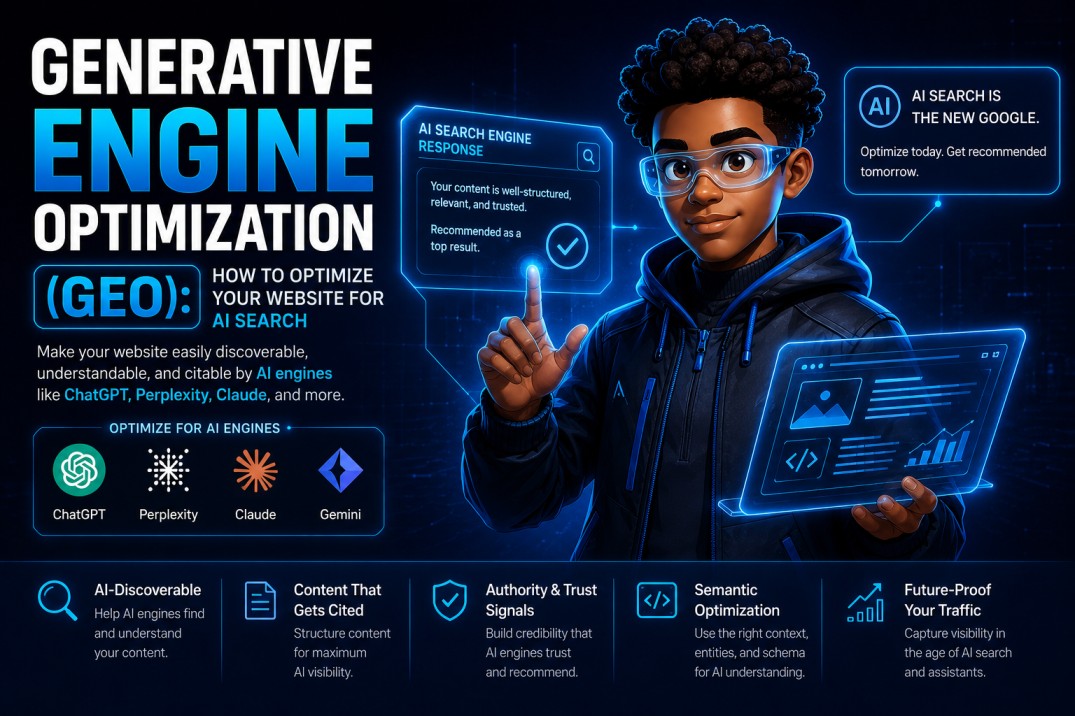
The internet just changed its entire blueprint, and most businesses haven't noticed yet.
For decades, search engine optimization (SEO) was a simple game: you stuffed keywords onto a page, built some backlinks, and tried to rank in Google’s list of "ten blue links."
But today, users are running away from traditional search bars. Instead of scrolling through pages of ads and sketchy links, they are asking ChatGPT, Gemini, and Perplexity complex questions and getting a single, synthesized answer on the spot.
If your website is buried under an unoptimized, slow, bloated WordPress template, AI crawlers will look at your code, get confused, and entirely skip your brand.
To stay visible, you need to transition from traditional SEO to Generative Engine Optimization (GEO). Here is exactly how to make your website completely effortless for AI engines to read, trust, and recommend.
The AI Filter: How Engines Choose Who to Cite
Think of traditional Google as a digital librarian who points users to a shelf of books. AI engines, on the other hand, act like an executive assistant—they read all the books on the shelf for you, summarize the best parts, and hand the user a clean report.
When a user asks an AI search engine a question, the system goes through an ultra-fast loop:
- The Scan: It sweeps the web looking for high-quality information related to the question.
- The Cut: It instantly filters out websites that are slow, messy, or full of code bloat.
- The Citation: It takes the cleanest data, builds an answer, and tags an official hyperlink to the website it stole the answers from.
If your code forces an AI bot to waste processing power trying to find your text among massive tracking scripts and useless code nesting, you lose. Speed and cleanliness aren't just for user experience anymore—they are your absolute baseline for survival in an AI-driven market.
The Speed Rule: High performance and hand-coded web profiles have a direct link to high AI retrieval rates. If your site loads instantly, an AI bot can parse your entire article before hitting its strict internal timeout rules
1. JSON-LD: Giving AI an Explicit Cheat Sheet
AI engines don't like guessing games. If they have to interpret a long, poetic paragraph to figure out what services you offer or who runs your agency, they might get it wrong—or skip you entirely.
The ultimate hack to fix this is JSON-LD Schema. This is a clean block of structured data that sits quietly in your website's backend header. It doesn't show up on the screen for your users, but it acts as an explicit graph mapping out exactly who you are to an AI bot.
Instead of hoping Gemini pieces your story together, you spell it out perfectly in machine-readable syntax:
JSON
{
  "@context": "https://schema.org",
  "@type": "ProfessionalService",
  "name": "Emmy STACK01",
  "description": "High-performance web engineering agency specializing in hand-coded digital profiles and technical SEO.",
  "url": "https://emmystack01.com",
  "founder": {
    "@type": "Person",
    "name": "Wisdom Ezuduemoih",
    "jobTitle": "Full-Stack Developer & Founder"
  },
  "knowsAbout": [
    "Technical SEO",
    "Generative Engine Optimization",
    "Full-Stack Web Engineering",
    "Minimalist Frontend Design"
  ]
}
By explicitly adding the knowsAbout array, you match your entity directly with core technical topics. When Perplexity looks for a trusted engineering authority on "Generative Engine Optimization," your profile lights up like a beacon.
2. Talk in Clean, Semantic HTML Structures
When AI bots scrap your site to pull data for answers, they look for clues on how the text is structured. If your content is buried inside generic, endless nested layers of <div> tags, the bot gets lost in the dark.
Your front-end markup needs to act as a clear, well-lit map. Look at the difference:
The Sloppy CMS Pattern (AI Blindness)
HTML
<div class="page-container-inner-final">
  <div class="custom-bold-text-style-large">What our team does</div>
  <div class="generic-paragraph-text">We build ultra-fast minimalist cards...</div>
</div>
The Clean, Semantic Pattern (High AI Discovery)
HTML
<article>
  <h2>Optimizing for Conversational AI Scrapers</h2>
  <p>We engineer ultra-fast, minimalist <strong>digital business cards</strong>...</p>
</article>
By wrapping your layout in an <article> tag, keeping your headings logical (<h2>), and emphasizing key terms with standard <strong> tags, you tell the scraper exactly where the gold is.
IS YOUR HOMEPAGE AN EMPTY AI BLINDSPOT?
If your root domain is sitting unmapped, running on a slow, bloated platform, or trapped behind an unoptimized template, AI search tools cannot see you. You are losing premium discovery traffic every single day.
UPGRADE TO A HIGH-PERFORMANCE WORKSPACE3. Designing Content for Conversational Answers
To make sure your brand keeps getting cited inside ChatGPT and Perplexity interfaces, layout your content with these simple principles:
- The Direct Answer Hook: Start your core technical sections with a clear, authoritative, single-sentence definition. AI models love copying and pasting direct summaries into their chat windows.
- Format with Tables and Lists: If you are displaying features, comparisons, or performance data, use structural HTML
<table>or<ul>tags. AI models interpret grouped data arrays infinitely faster than thick paragraphs. - Descriptive Hyperlinks: Never use generic phrases like "click here" for your outbound resources. Use descriptive anchors like
href="https://github.com/..."with clear, exact label properties.
The Bottom Line
Traditional SEO was about outsmarting an algorithm that scanned for keywords. Generative Engine Optimization is about proving your relevance to engines that read for logic, context, and code structural clarity.
By stripping out heavy tracking scripts, building precise semantic HTML templates, and backing your network structures with explicit JSON-LD data graphs, you transform your website into an authoritative source of truth that AI platforms will proudly quote.