Business Website vs Social Media Page: Which Do You Need?
Your business has an Instagram page, customers contact you on WhatsApp, and you're already using social media to promote your products or services.
So why spend money building a website?
It's a question many business owners ask, especially when social media seems to be doing the job already.
You can post pictures, share updates, communicate with customers, and even receive orders without owning a website.
But here's the thing.
A social media page and a business website aren't competing solutions. They serve different purposes, and understanding those differences can help you make better decisions for your business.
In this article, we'll compare both options, explain their advantages and limitations, and help you decide whether your business needs a website, a social media page, or both.
1. What Is the Difference Between a Business Website and a Social Media Page?
Let's start with the basics.
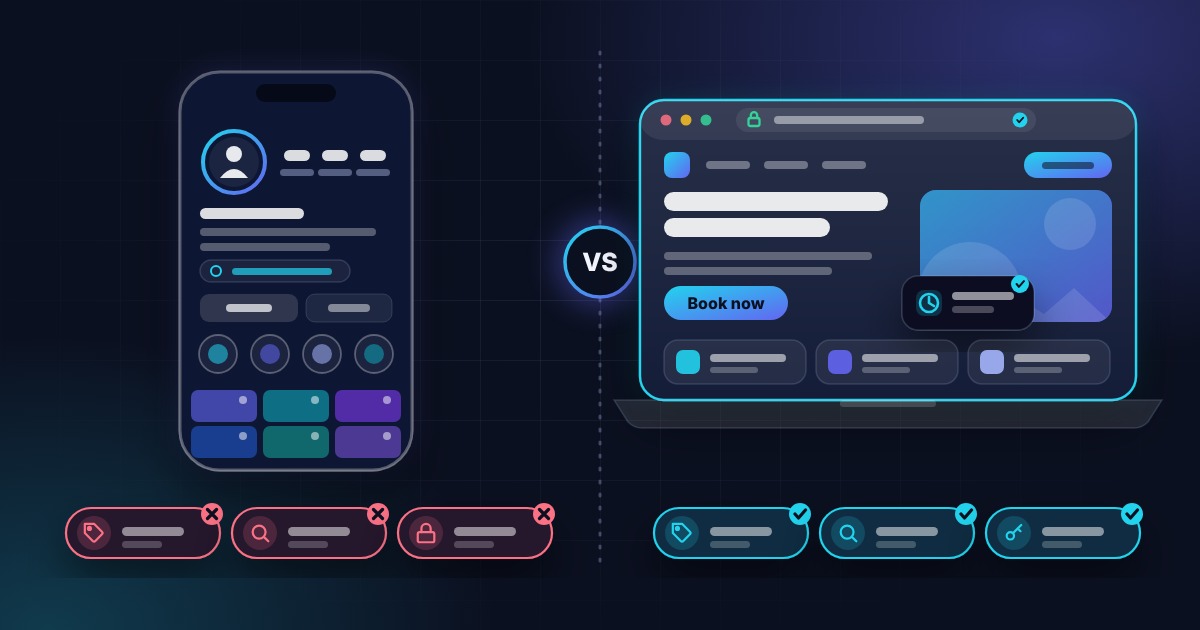
A social media page is your business's presence on a platform such as Instagram, Facebook, TikTok, or LinkedIn.
It allows you to publish content, interact with followers, respond to messages, and build a community around your business.
A business website is a collection of pages under your own domain that you use to present your business, explain your services, showcase your work, publish information, or sell products.
For example, a fashion designer might use Instagram to share new outfits, behind-the-scenes videos, and customer pictures.
The same designer could use a website to display collections, provide sizing information, explain ordering and delivery policies, and collect enquiries or orders.
Both can help the business attract customers, but they give customers different ways to interact with the brand.
Think of social media as a place where people discover and engage with your business.
Your website can serve as the central place where they find detailed information and take the next step.
And when the two work together, your business can benefit from both.
2. Which Is Better for Reaching New Customers?
This depends on how your customers discover businesses like yours.
Social media can be excellent for attracting attention.
A useful video, an interesting post, a recommendation, or a share from an existing customer can introduce your business to people who have never heard of you.
You can also interact directly with potential customers, participate in relevant conversations, and build relationships over time.
However, your reach may depend on the platform's recommendation systems, your existing audience, your content, and how people engage with it.
A website offers a different opportunity.
People use search engines such as Google to look for products, services, answers, and businesses.
If your website contains relevant information and is properly optimised, it can appear in search results for queries related to your business.
For example, someone searching for a wedding photographer in Lagos might discover a photographer's website through Google.
Someone else might discover the same photographer through an Instagram Reel.
Both routes can lead to a potential customer.
The important difference is that a website gives you a place to create content specifically designed to answer the questions people are searching for.
That can include service pages, location-specific information, useful articles, portfolios, and frequently asked questions.
However, having a website doesn't guarantee that people will find it through Google. Search visibility requires relevant content, good technical foundations, and time.
If your goal is to attract attention through social content, social media can be valuable. If you also want to build a presence in search results, a website gives you another channel to work with.
You don't have to choose only one.
3. Which One Builds More Trust?
Imagine you're looking for a company to handle an important project.
You find two businesses.
The first has a social media page with several posts and a phone number.
The second has an active social media presence and a website explaining its services, showing previous projects, introducing its team, and providing clear contact information.
Which business gives you more information to help you make a decision?
For many customers, the second business makes the evaluation process easier.
A website gives you more room to explain what your business does, how you work, what customers can expect, and why they should consider your services.
You can organise your information into dedicated pages rather than relying on people to scroll through your posts.
This can be particularly useful for:
- Consultants and professional service providers.
- Photographers and creative professionals.
- Law firms and other established service businesses.
- Schools and educational institutions.
- Businesses selling high-value products.
- Companies that need to showcase projects or case studies.
That doesn't mean a website automatically makes a business trustworthy.
An outdated website, misleading claims, broken pages, or missing contact information can create the opposite impression.
Likewise, a well-maintained social media page with genuine customer feedback and helpful content can build trust.
The real goal is to give potential customers reliable information and a clear understanding of your business.
A professional website simply gives you more control over how that information is organised and presented.
4. Which Gives You More Control?
This is one of the most important differences.
When you create a business page on a social media platform, you're operating within that platform's environment.
The platform controls its features, rules, algorithms, and account policies.
Changes to any of these can affect how you reach your audience.
If your account becomes inaccessible or your content reaches fewer people, your ability to communicate with followers may be affected.
Your website gives you another channel that you can manage more directly.
You can choose how your pages are organised, what information appears first, how customers contact you, and what features your business needs.
You also have greater control over your domain and website content, depending on your hosting arrangement and the tools you use.
However, a website isn't completely independent of third parties. Your domain registrar, hosting provider, payment processors, and other services may still be involved.
The practical advantage is that your entire digital presence doesn't have to depend on one social media platform.
Social media helps you build an audience on a platform. A website helps you establish a digital home for your business.
Both can be useful, but they play different roles.
5. Which Is Better for Selling Products and Services?
Both can help you sell.
The better option depends on what you're selling and how you want customers to buy from you.
Selling through social media
Social media can work well when your products are easy to showcase visually and customers are comfortable ordering through direct messages or WhatsApp.
For example, a small clothing business might post new arrivals, share customer pictures, answer questions, and receive orders through WhatsApp.
This can be a practical way to start selling without building a complete online store.
However, as your business grows, managing product information, orders, enquiries, and customer conversations across different platforms may become more difficult.
Selling through a website
A website can give customers a more structured way to explore your products or services.
Depending on how it's built, you can include:
- Product catalogues.
- Service descriptions and packages.
- Booking forms.
- Online payment options.
- Enquiry forms.
- Customer testimonials.
- Frequently asked questions.
- Clear ordering and delivery information.
For example, a photography business could display different packages and allow potential clients to submit booking enquiries.
A bakery could display its cake options, explain ordering requirements, and direct customers to place orders.
An online store could allow customers to browse products and complete purchases without manually discussing every item with the seller.
Of course, these features require appropriate setup, and some may involve additional costs.
You don't need all of them to get started.
The goal is to choose the option that makes buying from your business easier.
6. What About Cost? Is Social Media Cheaper?
In terms of getting started, a social media page is often the less expensive option.
You can usually create a business profile without paying for the basic account, publish content, and start interacting with potential customers.
A website requires additional considerations.
Depending on your approach, you may need to budget for domain registration, hosting, design, development, content creation, and ongoing maintenance.
The total cost depends on the type of website you need.
A simple website introducing your business and services will generally require less investment than a custom online store with complex functionality.
But comparing the two purely by their initial cost doesn't tell the whole story.
Consider the time you spend answering repetitive questions, manually sharing product information, explaining your services, or following up with potential customers.
A well-planned website may help reduce some of that work by making important information available in one place.
It may also support enquiries, bookings, or sales outside the moments when you're actively posting on social media.
These benefits aren't automatic. They depend on the quality of your website, the way you use it, and whether it addresses real customer needs.
Before deciding, think about what your business needs today and what it might need as it grows.
If you'd like to explore the available options, visit Emmy STACK01's pricing page.
7. Can a Social Media Page Help Your Business Appear on Google?
Yes, social media profiles can sometimes appear in Google search results.
For example, someone searching for your business name might find your Instagram, Facebook, or LinkedIn profile.
So it's not accurate to say that social media gives your business no visibility on Google.
However, a website gives you more opportunities to create and organise content around the products, services, and questions relevant to your customers.
You can build dedicated pages for individual services, locations, products, and topics.
You can also publish helpful articles that answer questions your potential customers are already asking.
For example, a photographer could have separate pages for wedding photography, corporate photography, and portrait sessions.
A school could provide detailed information about admissions, its curriculum, facilities, and school activities.
These pages give search engines more information about what the business offers.
Your website can also provide a foundation for improving your presence in AI-powered search experiences.
If you'd like to understand that side of online visibility, read our article on Generative Engine Optimisation (GEO): How to Optimise Your Website for AI Search.
Remember, neither a website nor a social media profile guarantees visibility. The important thing is to provide useful, relevant information and make it accessible to the people you're trying to reach.
8. What If You Don't Have the Budget for a Website Yet?
You don't have to build a website immediately just because your business is online.
If you're starting with a limited budget, focus on the basics.
Create a clear business profile, explain what you offer, use good product or service images, provide accurate contact information, and make it easy for customers to enquire or place orders.
You can also encourage satisfied customers to recommend your business and share genuine feedback.
At this stage, social media may be enough to help you test your offer and understand what customers want.
As your business develops, pay attention to the limitations you begin to experience.
Are potential customers asking for information you could organise on a website?
Are you struggling to showcase all your services clearly?
Do you want to attract people who search Google for the products or services you offer?
Are you spending too much time answering the same questions?
Do you need a more structured way to receive enquiries, bookings, or orders?
If the answer to these questions is increasingly yes, it may be time to consider a website.
You don't have to build an expensive platform with every possible feature.
Start with the pages and functionality your business genuinely needs.
You can expand as your needs change.
9. The Best Strategy? Use Both Together
For many businesses, the most practical solution isn't choosing between a website and social media.
It's using both for what they do best.
Imagine you run a fashion brand.
You use Instagram and TikTok to showcase new collections, post styling videos, and introduce your products to new audiences.
Interested customers visit your website to explore the full collection, check sizes, read delivery information, and place orders.
You share links to relevant website pages in your social media posts and profile.
Someone who discovers your business through Google can also visit your website without needing to find one of your social media posts first.
Now imagine you're a photographer.
You use social media to share recent shoots and connect with potential clients.
Your website presents your portfolio, packages, professional background, and booking information in one place.
Or perhaps you're a consultant.
You publish useful insights on LinkedIn, while your website explains your services, showcases your experience, and provides a way for interested clients to contact you.
In each example, social media attracts attention and encourages interaction, while the website provides a more structured destination for people who want to learn more or take action.
Your exact strategy will depend on your industry, audience, and budget.
But the principle remains the same: your channels should support one another rather than operate as disconnected parts of your business.
10. What If You Need Something Simpler Than a Full Website?
Not every professional or entrepreneur needs a large business website.
Sometimes, what you need most is a simple, professional way to share your contact information, services, portfolio, and social links.
For example, if you regularly attend networking events, meet potential clients, or connect with people in person, you may benefit from having a digital business card.
Instead of asking people to remember your phone number, search for your social media accounts, or keep track of a paper business card, you can share one link containing your professional information.
This can make it easier for people to find and contact you after an introduction.
Emmy STACK01 offers a Digital Business Card for professionals, creators, and entrepreneurs who want a dedicated place to present their digital identity.
It's worth understanding the distinction, though.
A digital business card is not necessarily a replacement for a complete business website.
It serves a more focused purpose: making your professional information easy to access and share.
If your main goal is to help people connect with you, a digital business card may be a useful starting point.
If you need detailed service pages, extensive content, a product catalogue, or more advanced business functionality, a full website may be more appropriate.
The right choice depends on what you're trying to achieve.
11. So, Which One Does Your Business Need?
Let's make the decision simpler.
A social media page may be enough for now if:
- You're just starting your business.
- You're testing a new product or service.
- Your budget is extremely limited.
- Most of your customers already find you through social platforms.
- You can comfortably manage your enquiries and orders through your current channels.
A website may be worth prioritising if:
- You want to attract customers through Google searches.
- You need a central place to explain your services.
- You want to showcase your portfolio or previous projects.
- You need a more structured way to generate enquiries or receive bookings.
- You want greater control over how your business information is presented.
- You want to build a longer-term online presence beyond social media.
Using both may be the best option if:
- You already have an active social media audience.
- You want to reach people who don't follow your accounts.
- You need a professional destination for potential customers.
- You want to combine content marketing, search visibility, and social engagement.
- You're ready to build a more complete digital presence for your business.
And if you're a professional who mainly needs to share contact information and make networking easier, a digital business card may be a useful addition to either approach.
The decision shouldn't be based on what every other business is doing.
It should be based on your goals, your customers, and the problems you need to solve.
Final Thoughts: Don't Choose a Platform. Choose What Your Business Needs.
A social media page can help your business attract attention, communicate with customers, and build an audience.
A website can give your business a central place to present information, build visibility through search, showcase your work, and support customer enquiries or sales.
Neither one guarantees business growth on its own.
What matters is how well you use each channel to serve your customers and achieve your goals.
If you're just starting out, social media may be enough to get moving.
As your business grows, a website can help you build on that foundation.
And when you combine the two strategically, you create more ways for people to discover your business, understand what you offer, and decide whether they want to work with you.
You don't need to be everywhere. You need to be where your customers can find you, and you need to give them a clear next step when they do.
Not sure what you need yet? That's fine. Start with your goals, and choose the solution that makes sense for your business.